Gold Hallmarks: How to Know What Your Jewellery Really Is
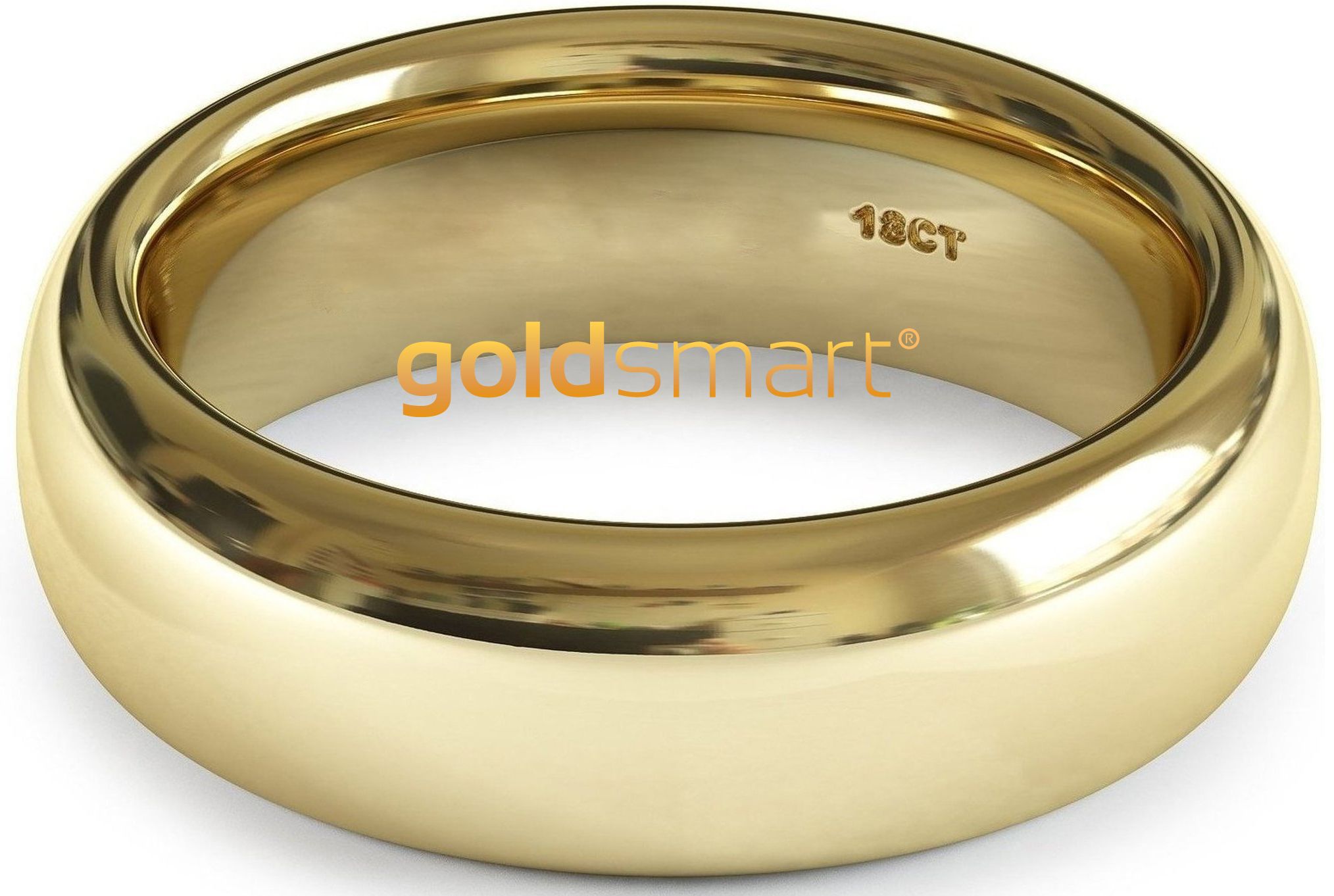
Understanding and knowing the value and composition of one’s jewellery is fundamental to being able to utilize the asset when it comes time to liquidate these pieces for future opportunities,…
Understanding and knowing the value and composition of one’s jewellery is fundamental to being able to utilize the asset when it comes time to liquidate these pieces for future opportunities, changes, or new jewellery choices. Too often people buy jewellery items or more commonly receive them as gifts, but there is poor-recordkeeping for what is actually received as a particular necklace, ring or bracelet. There is no question that jewellery can be valuable and it has culturally been a shared form of family treasure-keeping for centuries. In the Middle East, for example, women to this day stock up and keep fine jewellery as both decorative pieces as well as a personal financial stability resource if it is ever needed in an emergency. This tradition has gone on for hundreds of years, and it’s all the more reason why a jewellery owner today should have a good idea what kind of pieces are in one’s own collection.
Gold in fine jewellery can be identified in a number of ways, and the easiest methods are those that are already provided by manufacturers. Gold jewellery makers of established authority regularly use a variety of tools to identify their product and craftwork, better known as stamps and hallmarks. The identification symbols are well-recognized in the industry and immediately work as a verification of the gold content used in a particular piece. This is extremely helpful. In the same way the government-issued bullion coins make it easy for people of all backgrounds to identify quickly the worth and value of a given sovereign coin, stamps and hallmarks make it far easier to evaluate gold jewellery.

Hallmarks and Manufacturer Stamping
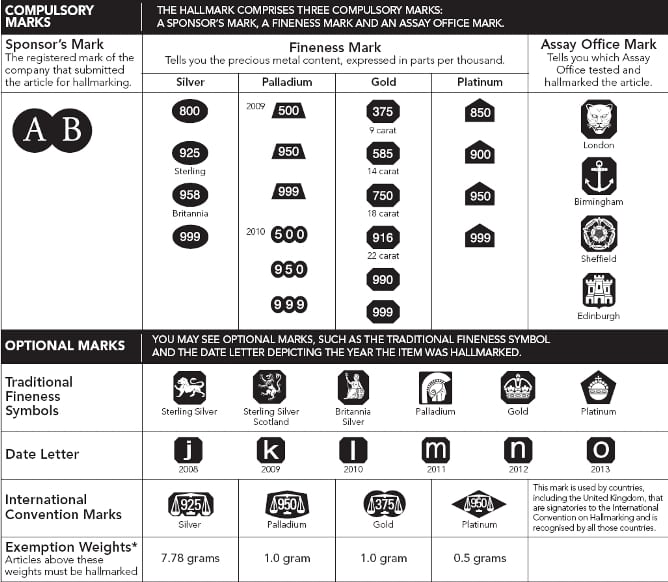
Gold quality stamps and hallmarks have been used for centuries to affirmatively identify the type of gold used in the given jewellery as well as who tested or confirmed the quality of gold involved as well. Eventually, these markings where then modified to identify a given goldsmith involved in the manufacturing as a branding stamp. Why have these marking continued into modern times with all the paperwork available and ability to digitally record data by the millions of records with computers? The reason is simple. How easily can the average person tell one gold jewellery item from another? Some think that the colour of the gold makes a difference that can be used as a metric but, in reality, most people just examining gold by eyesight alone cannot tell the difference between a 14 karat gold ring and a 24 karat gold ring-shaped the same. And that reason by itself has been more than enough to maintain the hallmark and stamp system that has existed for so many years.The Early History of Hallmarking
The use of gold hallmarks is definitely not new. In fact, the very first usage of gold jewellery hallmarks dates back to the 1200s. Hallmarking was invented to both identify the purity of the gold involved in a jewellery item as well as to identify who rated the piece and whether they could be trusted as a tester. Both were invaluable in a time when gold was regularly used for premium jewellery, coins and value protection. During the period of Edward I in England and Louis IX in France craft guilds were the dominant skilled-manufacturing force in Europe, and they were not without their local politics. To insure that what was produced by the guilds was indeed the advertised quality, state government assayers came into being as an objective regulator of sorts over guild products made with precious metals. Soon becoming successful, early craftmarking became a required prerequisite for any gold merchants who were going to sell a gold product in the regulated community. A century later, Edward III was recorded awarding the Worshipful Company of Goldsmiths a royal charter for their work and skill as well as brand protection, a form of early monopoly of the jewellery market. It was from this royal charter and the Goldsmiths’ existence in Goldsmiths’ Hall that the term “hallmark” originated. Fast forward to modern times, and gold items sold in the United Kingdom are regularly hallmarked, the only exception being products that individually weigh under 1 gram. The U.K.’s model has not been universal, however. Different countries have different hallmarking systems, and so the stamps on the jewellery involved vary depending where there were created geographically. The U.K. products are stamped from one of four assay locations. London is the most famous but the three others are in Birmingham, Edinburgh and Sheffield. Across the pond, however, the U.S. system is far looser and allows documentation separate from the jewellery itself, i.e. paperwork. Where a U.S. jewellery piece is marked, it must have both the quality mark and trademark stamp next to each other. China and India have no required system, and hallmark stamping in both countries is entirely a voluntary act. No surprise, the variation leads to a lot of doubt and extra testing on products from these countries. In Italy, on the other hand, gold jewellery markings include a stamp for the given manufacturer’s name as well as a grade of quality. Common gold names include Arezzo and Valenza, for example. Amazingly, hallmark stamping in Switzerland is entirely voluntary unless the gold is in the form of a metal watch case. The above said, Europe came together in 1972 and tried to standardize hallmarking via a convention agreement better known today as the Vienna System. It has been renamed the Common Control Mark or CCM, but the standards were originally spelled out by the Vienna Convention on the Control of the Fineness and the Hallmarking of Precious Metal Objects.
A Common Standard in Gold Jewellery Manufacturing
It is rare today to find gold jewellery sold in major markets without some kind of stamp, etching or hallmark for indication of quality and make. While these markings might be very hard for the average person to see or make out, experts know exactly what to look for right away. That said, there is still a lot of a variation in the stamps used, which still creates confusion in typing of a piece, even for a jewellery buyer. Fortunately, the large majority of items fall in line with the standards most manufacturers follow. The first big stamp to look for is the purity grade. This one matters the most to a gold buyer Auckland expert. While it can be different forms, the stamp indicates the type of gold used in the jewellery, ranging from 10 karat to 24 karat gold. The marking will either be an obscure 3-digit numeric set, such as 585, or it could be an obvious tell such as 14k for 14 karat. The 3-digit reference ties in with a common standards chart where number sets dictate the percentage of gold involved. 999, for example, is the purist amount, essentially 24 karat gold with a 99.9999% purity. On the other hand, 750 is indicative of a 75% purity level, better known to most as 18 karat gold. The 3-digit stamp sequence generally gets identified as follows:- 999.9 or 999 – 24 karat gold
- 995
- 990 – 23 karats
- 916, 917 – 22 karat gold
- 833 – 20 karats
- 750 – 18 karats
- 625 – 15 karat gold
- 585, 583, 575 – 14 karats
- 417 – 10 karat gold (typically the lowest one will find in U.S. markets)
- 375 – 9 karats
- 333 – 8 karat gold (typically the lowest one will find in German markets)
The Actual Hallmarking Creation Process
In the old days the markings put into a jewellery item were applied with a steel punch. In most cases the jewellery metal was softer, making this application a fairly easy if sensitive process to get the punch applied without damaging the item itself. Today, however, metal punching is extremely rare. Instead, laser etching is used, providing a far more accurate mark and avoiding the risk of impact damage to the jewellery involved. The modern U.K. hallmark will be made up of four types of marks. These are now, by standard, required, except for the date of manufacturer which ended in 1998. The four marks include:- Other countries vary in how they follow this
- The manufacturer’s mark
- The standard of fineness, otherwise known as purity
- The assay office involved that evaluated the item
- The date of testing and marking process or deviation from it
The Quality Content of Gold as a Standard
The manufacturing source is not the only criteria one should pay attention to when evaluating a jewellery collection. Yes, while 24 carats is the ideal standard to obtain, is 22 carats such a bad thing? How about 20 carats? Why are rings usually 12 and 14 carats and not higher? The quality of the gold content can have an even greater impact on the value of a collection than just who happens to be the crafter of the jewellery.
Carat Basics
When referring to gold by carat, it provides the most universally understood reference of gold purity in a jewellery piece. People could be far more technical by stating a given necklace has 90% gold and 10% other metal for mix and alloy strength. But that wouldn’t likely go over very well, and most folks would wonder what the other metal is and how could they verify its just 10 percent in the first place? The fact is, gold jewellery and other products made from gold need a bit of other metal in the mix to give them strength. Gold is an extremely soft metal and, on its own, would not last long as a jewellery piece. That said, carats provide an easier, more intuitive understanding that is easy to use whether one is a consumer or part of the gold industry. 24 carat is the finest, purest form of gold possible. This has practically no substantial metal in its mix and typically comes in .999 or .9999 purity. If one wants literally raw gold that has no other metals in it, then 24 carat is the standard to go by. However, while 24 carats is extremely valuable for its gold content, the form has very little utility because of its softness. Strong mixes allow gold to be used in forms that can take more wear and tear. Rings for example generally need to be strong as people use their hands on a regular basis and soft gold would essentially bend and eventually crack or break off over time. On the other hand, if one just wants gold for investment purposes, 24 carat gold is about as good as it gets for the finest version of the precious metal with the highest spot value and return.Symbols of Carat Quality
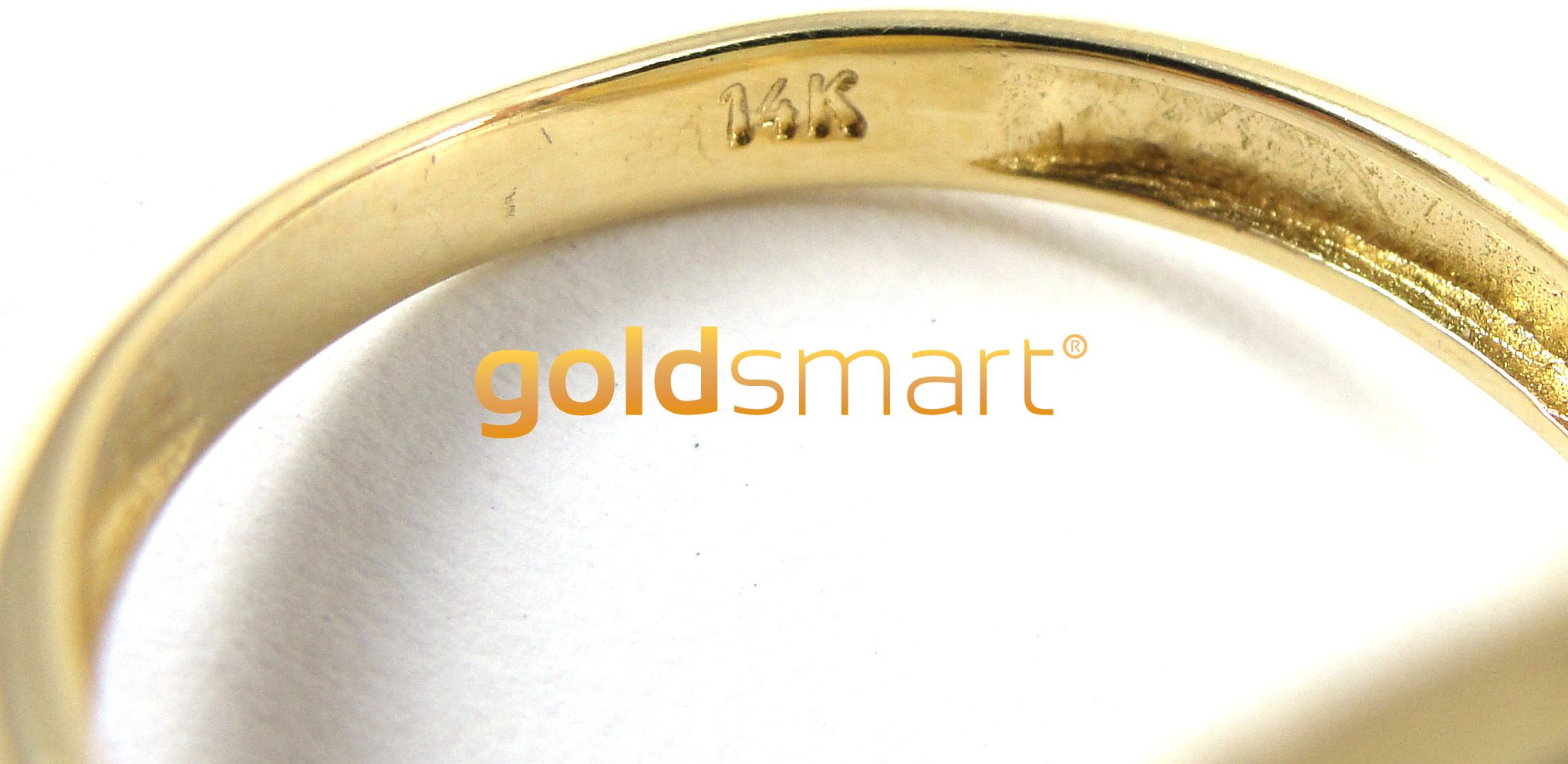
On jewellery pieces the most frequently used symbology tends to be a stamp or engraving of numbers and the letter “K” or “ct” for carat as a unit of measurement. The numbers will range from 8 to 24 for standard, universal carat reference. However, the numbers can also include three digit codes instead. In these cases, it doesn’t mean the gold is 333 carats. Instead, it is a simplified version of saying a gold piece has 33.3 percent pure gold in it. Most would otherwise recognize this meaning as 8 carats of gold, a very low quality gold content piece, usually found in a ring versus a bracelet or earring. Different carat values tend to be more or less common in different parts of the world. British Commonwealth countries have made wide use of the 9 carat standard for lower cost jewellery. This is identified as 9K or 9ct or 375. Interestingly, it would very rare to find a 9 carat jewellery piece in countries like the U.S. however, which instead favors 8, 10 and 12 carat for lower quality gold jewellery. The even numbers have long been used in marketing, so the 9 carat version is practically unheard of there. Worldwide, on the other hand, the 10 carat jewellery piece is well-recognized and can be found with stamps of 10K, 10ct and 416, again representing 41.6 percent fine gold content. This is the ideal balance between metal strength and gold luster that sells well in all types of markets. 14 carat jewellery uses the same stamp pattern of 14K, 14ct or 585 for 58.5 percent pure gold content. This value range has a bit of confusion in it because of the Russian market. In Russia, a 14 carat jewellery item actually include 58.4 percent fine gold content, not 58.5 percent. While being a slight difference, internationally Russian gold is getting mixed up with the rest of the world and, as a result produces variation in 14 carat jewellery, depending on the source. And U.S. markets now sell a 14 carat gold criteria that is 58.3 percent pure, just to confound things further. There is also a 15 carat version, which is very uncommon and appears with 15K, 15ct, or 625 on the quality marking. It’s rarity has a lot do with the fact that the mixture was effectively ended back in the 1940s. As a result, while pieces do exist, they appear as estates are liquidated or jewellery is passed down to later generations from earlier holders. From the 15 carat level gold then makes a jump to 18 carats. Again, similar symbology is used to show 18K, 18ct or 750. It equal 75 percent gold purity. 18 carats took over the 15 carat level decades after and generally became the same representation in terms of labeling. 22 carats has the same symbology above for its level and gets a three digit code of 916 for being 91.6 percent pure fine gold. Finally, the 24 carat level represents the zenith of gold purity with an effective 100 percent fine gold content. When used in jewellery it is for pieces that generally don’t require or get exposed to stress and pressure and will essentially supported. It typically has a 24K or 1000 code stamped on the piece to mark it’s quality level. Most jewellery manufacturers tend to avoid 24 carat gold for their products because it is so easy to bend and break, but there is a market for fine gold pieces simply for the sake of wearing the most valuable gold possible.